
Rough Terrain Forklift vs. Standard Diesel Forklift: How to Choose?
1. Introduction
Choosing the right forklift is important for improving material-handling efficiency, controlling operating costs, and maintaining safe working conditions. However, not every forklift is designed for the same environment. A forklift that performs well on smooth warehouse floors may not be the best choice for a construction site, farm, lumber yard, or uneven outdoor work area.
Two common options are the rough terrain forklift and the standard diesel forklift. Both use diesel engines and are designed to lift and move materials, but their structures, tires, ground clearance, stability characteristics, and intended applications are different.
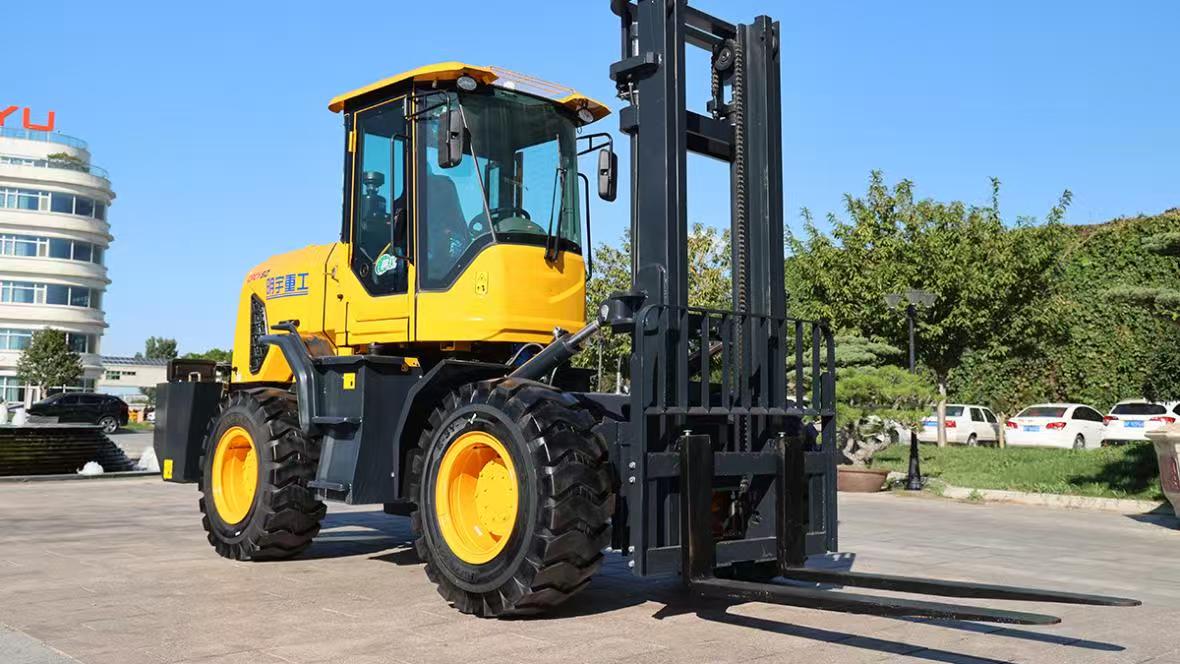
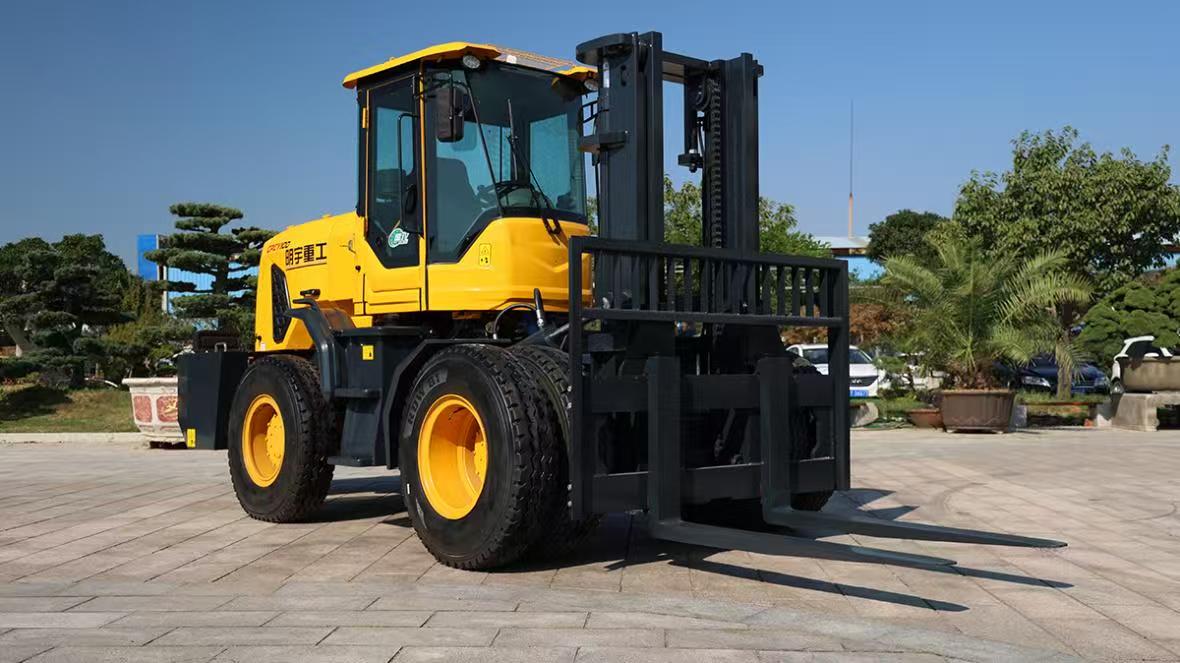
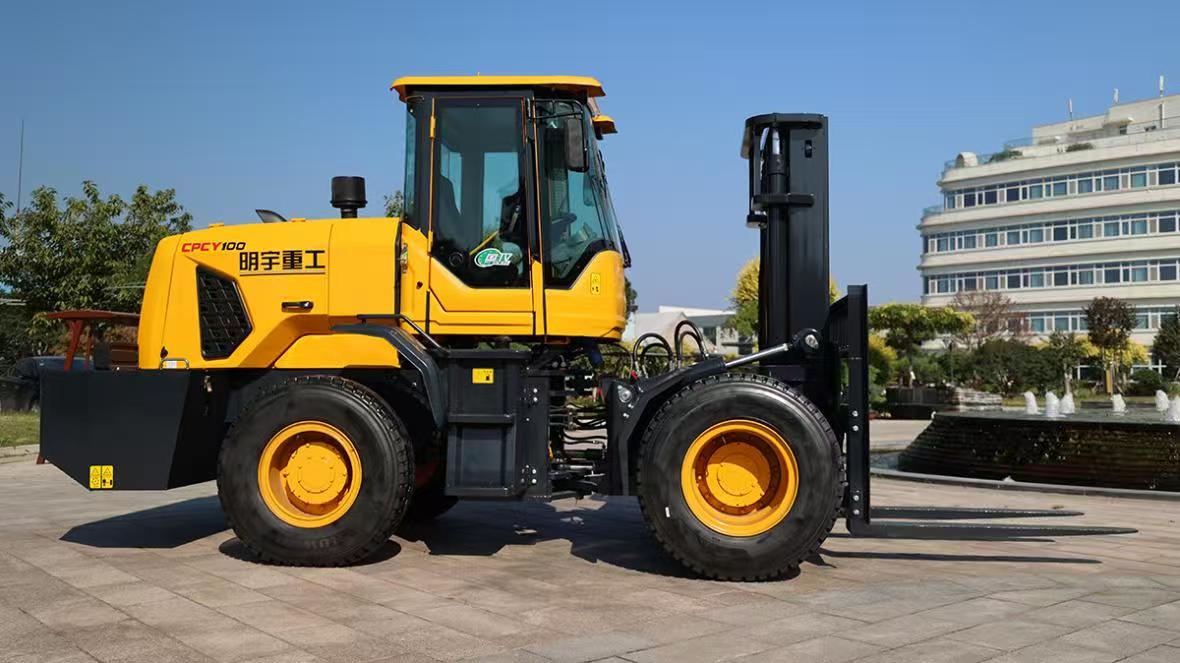
A rough terrain forklift is specifically designed for demanding outdoor environments. It typically features large pneumatic tires, greater ground clearance, a robust chassis, and strong traction. These characteristics allow it to travel over gravel, dirt, uneven ground, construction sites, and other challenging surfaces.
A standard diesel forklift is generally designed for relatively smooth and firm surfaces. It is commonly used in factories, warehouses, logistics yards, and industrial facilities. Depending on the configuration, it can also work outdoors on paved or relatively stable surfaces.
So, which one should you choose? The answer depends primarily on where the forklift will work, what loads it will handle, how high it needs to lift, and how frequently it will operate. This article compares rough terrain forklifts and standard diesel forklifts in terms of design, performance, tires, operating costs, applications, and maintenance to help buyers make a more suitable choice.
2. What Is a Rough Terrain Forklift?
A rough terrain forklift is a forklift specifically designed for outdoor material handling on uneven or unprepared surfaces. It is commonly used in construction, agriculture, forestry, landscaping, building-material yards, and other applications where ordinary industrial forklifts may have difficulty operating.
One of its most recognizable characteristics is its large pneumatic tires. These tires provide better traction and help the forklift travel across dirt, gravel, loose soil, and uneven surfaces.
Rough terrain forklifts also generally have greater ground clearance than standard warehouse forklifts. This reduces the possibility of the chassis or undercarriage contacting obstacles on rough ground.
The chassis is typically designed to withstand demanding outdoor conditions. Depending on the model, a rough terrain forklift may also feature four-wheel drive or other traction-enhancing systems.
These characteristics make rough terrain forklifts particularly useful when materials need to be moved directly around construction sites or agricultural fields rather than only on prepared concrete surfaces.
3. What Is a Standard Diesel Forklift?
A standard diesel forklift is a conventional counterbalanced forklift powered by a diesel engine. It is widely used for loading, unloading, stacking, and transporting materials in industrial and commercial environments.
Standard diesel forklifts are commonly available in different lifting capacities and mast configurations. They can be equipped with pneumatic tires or other tire types depending on the intended application.
Compared with rough terrain forklifts, standard diesel forklifts generally have a more compact design and are optimized for relatively smooth, firm surfaces. They are commonly used in factories, warehouses with suitable ventilation, logistics yards, ports, and outdoor industrial areas.
Their counterbalanced configuration allows the forklift to lift loads without requiring front outriggers. The counterweight at the rear balances the weight of the load being lifted.
For businesses that mainly work on concrete, asphalt, or other prepared surfaces, a standard diesel forklift can often provide a practical combination of lifting performance, maneuverability, and operating cost.
4. Rough Terrain Forklift vs. Standard Diesel Forklift: Key Differences
The most important difference is the working environment.
A rough terrain forklift is designed for uneven outdoor surfaces, while a standard diesel forklift is generally better suited to smooth and firm ground.
Their tire designs are also different. Rough terrain forklifts typically use large pneumatic tires with deep tread patterns. Standard diesel forklifts may use pneumatic, solid, or other industrial tires depending on the model.
Ground clearance is another important difference. Rough terrain models usually have greater clearance, allowing them to travel over obstacles and uneven terrain more easily.
The chassis and drivetrain of a rough terrain forklift are also designed with outdoor mobility in mind. Some models offer four-wheel drive, which can provide additional traction when operating on loose or uneven ground.
Standard diesel forklifts, in comparison, are often more compact and maneuverable in confined industrial environments.
Therefore, neither machine is automatically "better." Each is designed for a different purpose.
5. Performance on Different Terrains
Terrain is one of the most important factors when selecting a forklift.
On smooth concrete floors, a standard diesel forklift can generally perform efficiently. Its compact design and maneuverability can be particularly useful in industrial facilities.
On asphalt, both types can work effectively if the surface is firm and reasonably level.
On gravel and dirt roads, rough terrain forklifts have a clear advantage. Their larger tires, higher ground clearance, and stronger traction allow them to handle these surfaces more effectively.
On muddy or uneven terrain, rough terrain models are generally more suitable, particularly when equipped with appropriate tires and drive systems.
Slopes also require careful consideration. A forklift's maximum gradeability depends on its engine, transmission, drive system, load, terrain, and operating conditions. Buyers should always check the manufacturer's specifications rather than assuming that a particular forklift can safely operate on any slope.
6. Lifting Capacity and Load Handling
Both rough terrain and standard diesel forklifts are available with different lifting capacities.
When selecting a forklift, the buyer should first determine the maximum load weight that must be handled. However, rated capacity alone is not enough.
The load center is also important. A forklift rated for a particular capacity at a specified load center may have a lower allowable capacity when the load center is farther away.
Lifting height is another consideration. If materials need to be stacked on high racks or loaded onto high platforms, the mast configuration and maximum lifting height must be appropriate.
For construction materials, long loads, pallets, pipes, timber, or other unusual cargo, attachments may also be required. Side shifters, fork positioners, clamps, and other attachments can change the forklift's actual lifting characteristics.
Therefore, buyers should evaluate the complete load-handling requirement instead of choosing a forklift based only on the maximum rated capacity.
7. Tire Selection and Traction
Tires have a major influence on forklift performance.
Rough terrain forklifts typically use large pneumatic tires with tread patterns designed for outdoor surfaces. They provide cushioning and improved traction when traveling over uneven ground.
Standard diesel forklifts may use pneumatic tires when outdoor operation is required, or solid tires for applications where puncture resistance and durability are more important.
Pneumatic tires can provide better cushioning on uneven surfaces, while solid tires can be advantageous in environments where sharp objects may damage conventional pneumatic tires.
For rough terrain applications, tire selection should consider soil conditions, surface hardness, moisture, slope, and the type of material being transported.
Using the wrong tires can reduce traction, increase wear, and negatively affect both productivity and operating costs.
8. Fuel Consumption and Operating Costs
Fuel consumption is another factor buyers should consider.
A rough terrain forklift may consume more fuel than a smaller standard diesel forklift because it can have a larger engine, heavier chassis, larger tires, four-wheel drive, and higher power requirements for outdoor operation.
However, fuel consumption should always be considered together with productivity.
For example, using a standard forklift on rough ground may result in slow operation, wheel spin, increased tire wear, or difficulty transporting loads. Even if the machine has a lower theoretical fuel consumption, its overall operating cost may be higher because it cannot perform the job efficiently.
Maintenance costs should also be considered. Tire replacement, engine maintenance, hydraulic system maintenance, transmission servicing, and spare parts all contribute to the total cost of ownership.
The best forklift is therefore not necessarily the one with the lowest purchase price or fuel consumption. It is the one that provides the required performance at a reasonable total operating cost.
9. Maneuverability and Operator Comfort
Maneuverability is particularly important when the forklift operates in confined spaces.
Standard diesel forklifts are often relatively compact and can be suitable for industrial facilities where the operator needs to turn within limited spaces.
Rough terrain forklifts are usually larger and designed to prioritize outdoor mobility and stability. Some models may have larger turning radii, although steering configurations vary between machines.
Operator comfort is also important. Outdoor operators may spend many hours traveling across uneven terrain. A well-designed seat, suspension system, ergonomic controls, good visibility, and appropriate operator protection can improve working efficiency.
Visibility is especially important when lifting large or bulky loads. The mast, carriage, load, and attachments should not create unacceptable blind spots.
10. Which Forklift Is Better for Construction Sites?
For most demanding construction-site applications, a rough terrain forklift is generally the more suitable choice.
Construction sites often contain unfinished surfaces, gravel, dirt, slopes, mud, and other obstacles. Materials may need to be moved from delivery trucks to different locations across the site.
A rough terrain forklift can provide better traction and ground clearance in these conditions. Its large tires and robust chassis allow it to operate more effectively where a standard industrial forklift may struggle.
Typical construction applications include:
Moving bricks and blocks
Handling steel materials
Transporting timber
Moving construction equipment
Loading and unloading trucks
Transporting pallets across unfinished ground
However, the exact machine should still be selected according to the required lifting capacity, lifting height, load center, terrain, and working conditions.
11. Which Forklift Is Better for Warehouses and Factories?
For warehouses and factories with smooth concrete floors, a standard diesel forklift may be more practical, especially when outdoor ventilation is suitable and diesel power is specifically required.
Standard forklifts are often easier to maneuver in industrial environments and can be available in a wide range of capacities and mast configurations.
However, if a warehouse frequently requires outdoor loading and unloading on rough ground, a rough terrain forklift may be more suitable.
It is also important to consider indoor operating conditions. Diesel engines produce exhaust emissions, so indoor use requires appropriate ventilation and compliance with applicable workplace regulations. In many indoor applications, electric forklifts may be considered instead.
The choice should therefore consider not only the ground surface but also ventilation, operating space, working hours, load requirements, and local regulations.
12. Application Comparison
Different industries have different requirements.
Construction
Rough terrain forklift: Generally preferred because of uneven ground and outdoor working conditions.
Agriculture
Rough terrain forklift: Suitable for farms, storage yards, and outdoor material handling where surfaces may be uneven.
Lumber Yards
Rough terrain forklift: Often suitable for outdoor timber handling, particularly on gravel or dirt surfaces.
Landscaping
Rough terrain forklift: Useful for moving soil, stone, plants, pallets, and landscaping materials across uneven terrain.
Industrial Plants
Standard diesel forklift: Suitable for firm and prepared outdoor surfaces, depending on ventilation and operating requirements.
Warehouses
Standard diesel forklift: Suitable for appropriate outdoor or well-ventilated industrial environments with smooth floors.
Logistics Yards
Standard diesel forklift: Can be practical on paved surfaces for loading and unloading trucks.
Ports
The choice depends heavily on the surface, load type, lifting capacity, and environmental requirements. Heavy-duty standard forklifts may be suitable for prepared yards, while rough terrain models may be useful in specific uneven outdoor areas.
13. How to Choose the Right Forklift
The first step is to identify the working environment.
Ask:
Is the ground concrete, asphalt, gravel, dirt, or mud?
Is the surface level or uneven?
Will the machine work indoors or outdoors?
Are there slopes or obstacles?
Next, determine the maximum load weight and load dimensions.
Then check the required lifting height and load center. These factors directly influence the appropriate mast and capacity.
The tire type should then be selected according to the terrain.
Buyers should also consider:
Engine power
Transmission type
Drive configuration
Ground clearance
Turning radius
Fuel consumption
Maintenance requirements
Attachment requirements
Spare-parts availability
After-sales service
The right choice is the machine that matches the actual working conditions rather than simply the machine with the largest capacity or lowest price.
14. Common Mistakes When Choosing a Forklift
One common mistake is choosing a forklift based only on the purchase price.
A cheaper machine may have higher fuel consumption, faster tire wear, more maintenance requirements, or insufficient performance for the application.
Another mistake is choosing a forklift with excessive lifting capacity. A larger machine may cost more to purchase and operate without providing meaningful benefits if the actual loads are relatively light.
Ignoring terrain conditions is another serious mistake. A standard forklift designed for smooth floors should not automatically be expected to perform efficiently on rough construction sites.
Buyers should also avoid choosing tires without considering the actual working surface.
Finally, it is important not to overlook the load center. The actual safe capacity can be lower than the nominal rated capacity when the load is positioned farther forward.
15. Frequently Asked Questions
Can a rough terrain forklift be used on concrete floors?
Yes. A rough terrain forklift can operate on concrete, but it may be larger and less maneuverable than a standard industrial forklift. If the majority of work is indoors or on smooth floors, a standard forklift may be more appropriate.
Can a standard diesel forklift work on rough terrain?
Some standard forklifts with pneumatic tires can operate on firm outdoor surfaces, but they are generally not designed for severe uneven terrain, deep mud, or difficult construction sites.
Which forklift has better lifting capacity?
Both types are available in different capacities. The best choice depends on the actual load, load center, lifting height, and working environment rather than the forklift category alone.
Which one consumes less fuel?
A smaller standard diesel forklift may consume less fuel, but actual consumption depends on engine size, load, terrain, working cycle, and operator behavior.
Which forklift is better for construction sites?
For uneven outdoor construction sites, a rough terrain forklift is generally more suitable because of its tires, ground clearance, traction, and outdoor-oriented design.
Which forklift is better for agriculture?
For agricultural applications involving dirt roads, fields, gravel, or uneven yards, a rough terrain forklift is often the better choice.
Are rough terrain forklifts more expensive?
They can have a higher purchase price because of their larger tires, stronger chassis, drivetrain, and off-road capabilities. However, the total value depends on how well the machine matches the application.
Can either forklift use attachments?
Yes. Depending on the model and manufacturer, forklifts can be equipped with attachments such as side shifters, fork positioners, clamps, rotating attachments, and other specialized equipment. The attachment's weight and load center must be considered when determining the remaining lifting capacity.
16. Conclusion
The choice between a rough terrain forklift and a standard diesel forklift should be based primarily on the working environment and actual material-handling requirements.
A rough terrain forklift is generally the better choice for construction sites, agricultural areas, gravel yards, dirt roads, landscaping projects, and other applications involving uneven or unprepared surfaces. Its large tires, high ground clearance, strong traction, and robust construction allow it to work more effectively in challenging outdoor conditions.
A standard diesel forklift is generally more suitable for factories, warehouses, logistics yards, and other environments with firm and relatively smooth surfaces. Its compact design, maneuverability, and wide range of configurations make it practical for conventional material handling.
Before purchasing, buyers should carefully evaluate terrain, load capacity, load center, lifting height, tire type, operating hours, fuel consumption, maintenance, and total cost of ownership.
Ultimately, there is no universally better forklift. The best machine is the one that matches the working conditions and performs the required job efficiently, reliably, and safely.
Post time:Aug.26.2026
