
When considering the operational capabilities of material handling equipment, the question of speed often surfaces, particularly for machines designed for challenging environments. For rough terrain forklifts, commonly known as telehandlers, the answer to "how fast can they travel?" reveals a fascinating intersection of engineering, functionality, and stringent safety protocols. Unlike their electric-powered warehouse counterparts, which operate on smooth, predictable surfaces, rough terrain forklifts are diesel or LPG-powered workhorses built for construction sites, lumber yards, and agricultural fields. This fundamental difference in purpose dictates their design and, consequently, their travel speed. A typical rough terrain forklift can achieve a top travel speed in the range of 15 to 25 miles per hour (approximately 24 to 40 kilometers per hour) when unloaded and on a firm, level surface. This is significantly faster than the 6-8 mph typical of an indoor forklift, a necessity born from the need to traverse large, open job sites efficiently. However, this top-speed figure is almost irrelevant in day-to-day practice. It represents a mechanical maximum under ideal conditions—a rare scenario in the rugged, uneven, and dynamic environments these machines are built for. The true measure of a rough terrain forklift's "speed" is not its top-end velocity but its controlled, adaptable, and safe transit over variable ground conditions, where stability and precision far outweigh the need for haste.
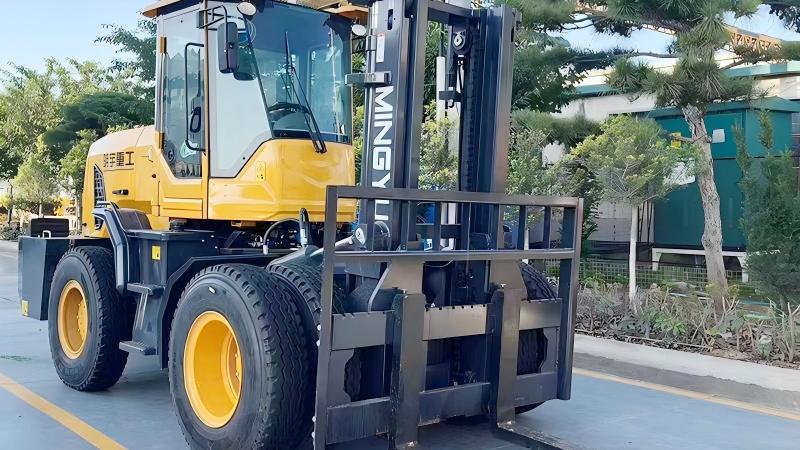
The design and engineering of a rough terrain forklift are explicitly tailored to prioritize power, stability, and traction over pure velocity. Key features such as large, heavy-tread pneumatic tires, a robust four-wheel drive system, and a high ground clearance are essential for navigating mud, gravel, sand, and slopes. These very features that provide off-road capability also impose natural limits on safe travel speed. The large, soft tires and suspended axles necessary for absorbing bumps and maintaining traction can reduce lateral stability at higher speeds, especially when turning. Furthermore, the machine's center of gravity is a dynamic variable. Unlike a warehouse forklift with a relatively fixed counterweight, the telehandler's center of gravity shifts dramatically with the boom's extension, elevation, and load placement. Traveling with an elevated or extended load, even unloaded, is extremely dangerous and is strictly prohibited by safety standards; the machine must be in a "travel position" with the boom lowered and retracted. Even in this position, the inherently higher center of gravity compared to a standard forklift means that speed must be meticulously managed to prevent a tip-over, particularly on slopes or uneven terrain. Manufacturers engineer these machines with powerful engines not primarily for speed, but for the torque needed to climb grades, push through soft ground, and power hydraulic systems simultaneously. The transmission, often with multiple gears, allows for a low range for precise, high-torque maneuvering and a high range for site transit, always with the understanding that the latter is used judiciously.
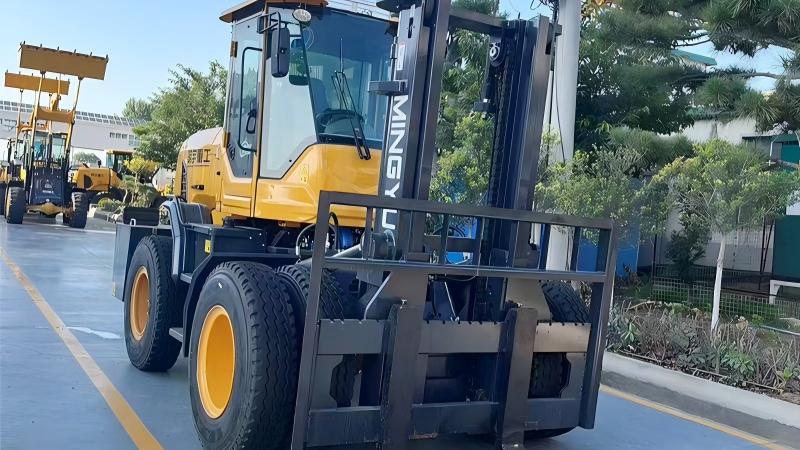
Safety regulations and operational best practices form the absolute governor on a rough terrain forklift's travel speed. Governing bodies like the Occupational Safety and Health Administration (OSHA) in the United States do not set a single numerical speed limit but establish the critical performance-based rule: equipment must be operated at speeds safe for conditions. For rough terrain operations, "conditions" are the defining constraint. A safe speed on a dry, level dirt path is vastly different from a safe speed on a rain-slicked slope, a congested site with multiple trades working, or an area with hidden ruts and debris. Formal training and certification for operators, mandated by OSHA, heavily emphasize situational speed judgment. Key safety protocols that drastically limit travel speed include: always traveling with the load low and pointed uphill on slopes, reducing speed for turns and congested areas, sounding the horn at blind corners, and never exceeding a speed where the machine can be stopped within a clear line of sight. Furthermore, site-specific rules established by the general contractor or site manager often impose strict speed limits, such as 10 mph or even 5 mph, throughout the job site to protect pedestrians, other vehicles, and infrastructure. The operator’s primary responsibility is to transport loads safely and productively, not quickly. A single incident caused by excessive speed—a tip-over, a collision, or a dropped load—can result in catastrophic injury, fatality, massive property damage, and project delays, completely negating any perceived time saved.
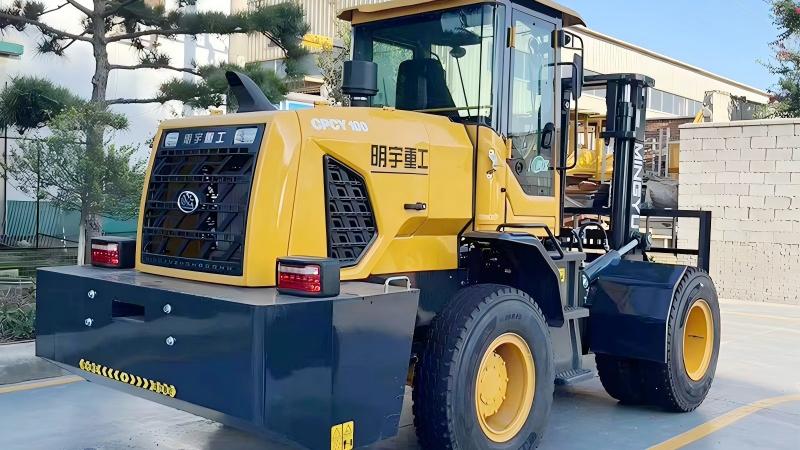
Ultimately, the operational reality for a rough terrain forklift driver is one of constant, vigilant speed modulation based on a real-time assessment of multiple, interconnected factors. The machine's capability is a tool, not a mandate. Experienced operators understand that the terrain itself dictates the pace: crawling over deeply rutted ground, proceeding cautiously on a side slope to maintain stability, and only utilizing higher travel gears on established, wide, and clear site roads. The load itself is a major consideration; even a secure, low load affects the machine's momentum and braking distance. Weather conditions are perhaps the most significant variable, as rain, snow, or ice can turn stable ground into a hazardous slide, requiring speeds to drop to a crawl. Technological aids like load moment indicators and stability monitoring systems warn operators of dangerous conditions but do not replace seasoned judgment. In conclusion, while a rough terrain forklift possesses the mechanical ability to travel at highway-like speeds, its functional and safe operating speed is a fraction of that potential. The machine's true value lies in its powerful, controlled, and adaptable movement in unforgiving environments, where the wisdom of the operator in managing speed is the most critical safety feature of all. Productivity on a job site is measured by safe and consistent cycle times, not by top speed, making disciplined, situational awareness the non-negotiable key to effective operation.
Post time:Jan.15.2026
