
Which Forklift Type Is More Suitable for Indoor Warehouse Operation?
1. Introduction
Forklifts are essential material-handling machines in modern warehouses, distribution centers, manufacturing facilities, and logistics operations. They are used to move pallets, load and unload trucks, transport materials, and place goods on storage racks. However, not every forklift is equally suitable for indoor warehouse operation. Choosing the right forklift type can directly affect productivity, operating costs, workplace safety, and the efficiency of the entire warehouse.
Indoor warehouses have different requirements from outdoor construction sites or industrial yards. Operators may need to work in narrow aisles, around pedestrians, on smooth concrete floors, and inside enclosed buildings where exhaust emissions and noise must be controlled. At the same time, some warehouses require forklifts to operate for many hours every day and lift loads to considerable heights.
The most common forklift options for indoor applications include electric counterbalance forklifts, lithium-ion forklifts, reach trucks, pallet stackers, LPG forklifts, and, in some special cases, diesel forklifts. Each type has its own advantages and limitations. In general, electric forklifts are one of the most suitable choices for indoor warehouses because they produce no tailpipe emissions, operate relatively quietly, and provide precise handling. However, the best solution depends on the warehouse layout, load requirements, lifting height, operating hours, and budget.
2. What Makes a Forklift Suitable for Indoor Warehouse Operation?
Before choosing a forklift, warehouse managers should evaluate the actual working environment rather than simply selecting the most powerful machine. Several factors determine whether a forklift is suitable for indoor use.
First, the warehouse floor should be considered. Most indoor forklifts are designed for relatively smooth and level concrete floors. Electric forklifts, reach trucks, and pallet stackers perform particularly well on these surfaces. If the floor has ramps, uneven areas, or obstacles, a forklift with suitable ground clearance and traction may be necessary.
Second, the required load capacity is important. Warehouses handling standard pallets may only need a 1.5-ton or 2-ton forklift, while industrial warehouses may require 3-ton, 3.5-ton, or higher-capacity equipment. The rated capacity should always be selected according to the actual load and load center.
Aisle width is another critical factor. A conventional counterbalance forklift requires more space to turn, while a reach truck or pallet stacker can operate efficiently in narrower aisles. For high-density warehouses, choosing a compact forklift can allow more storage locations without expanding the building.
Lifting height should also be considered. If goods are stored on high racks, the forklift must have sufficient mast height and residual lifting capacity. Finally, managers should consider operating hours, charging infrastructure, emissions, noise, maintenance requirements, and total cost of ownership.
3. Electric Forklifts for Indoor Warehouses
Electric forklifts are among the most popular choices for indoor warehouse operations. They are powered by batteries rather than internal combustion engines and are available in different capacities and configurations.
One of their biggest advantages is the absence of tailpipe exhaust emissions. This makes electric forklifts particularly suitable for enclosed warehouses where ventilation may be limited. They are also quieter than diesel-powered machines, which can create a more comfortable working environment for operators and other warehouse employees.
Electric forklifts also provide smooth acceleration and precise control. This is useful when operators need to position pallets accurately on racks or work close to other equipment and pedestrians.
Traditional lead-acid batteries are still used in many warehouses because they are well-established and relatively economical. However, lithium-ion batteries have become increasingly popular. Lithium-ion forklifts can support opportunity charging, have high energy efficiency, and generally require less routine battery maintenance than conventional lead-acid systems.
The main disadvantages of electric forklifts include the need for charging infrastructure and the initial purchase cost, which can be higher than some internal-combustion alternatives. For multi-shift warehouses, companies should carefully plan battery capacity, charging schedules, and the number of batteries required.
4. LPG Forklifts for Indoor Warehouse Operations
LPG forklifts use liquefied petroleum gas as fuel and are commonly used in applications where operators want fast refueling and longer continuous operating periods.
One advantage of LPG forklifts is that refueling is generally much faster than recharging a battery. This can be useful for operations that run continuously and cannot afford long charging periods. LPG forklifts can also be suitable for facilities that require both indoor and outdoor material handling.
However, LPG forklifts produce exhaust emissions. Although they can be used indoors in appropriate environments with sufficient ventilation, warehouse managers need to consider air quality, local regulations, building ventilation, and the specific operating conditions.
LPG forklifts can therefore be a practical option for warehouses with good ventilation and intensive operating schedules. However, where low emissions and low noise are major priorities, electric forklifts are usually more attractive.
5. Diesel Forklifts: Are They Suitable for Indoor Warehouses?
Diesel forklifts are powerful machines designed primarily for demanding material-handling applications. They provide strong torque and are particularly useful for heavy loads and outdoor operations.
For a typical enclosed warehouse, however, diesel forklifts are usually not the first choice. Their internal-combustion engines produce exhaust gases and generally create more noise than electric forklifts. Adequate ventilation is therefore important when diesel equipment is operated indoors.
Diesel forklifts can still be considered in certain industrial environments, especially when the warehouse is large, well ventilated, and handles very heavy loads. They may also be useful when the forklift frequently moves between indoor and outdoor areas.
For standard indoor logistics operations involving pallets and moderate loads, an electric forklift will usually provide a cleaner and quieter solution. Diesel forklifts are generally more appropriate for outdoor yards, construction sites, ports, and other demanding environments.
6. Reach Trucks and Pallet Stackers for Narrow Aisles
Not every warehouse requires a conventional counterbalance forklift. In facilities with narrow aisles and high storage racks, reach trucks can be a highly efficient solution.
Reach trucks are designed to operate in relatively narrow spaces and can lift pallets to significant heights. Their compact design allows warehouses to increase storage density by reducing aisle width. They are particularly common in distribution centers and high-bay storage facilities.
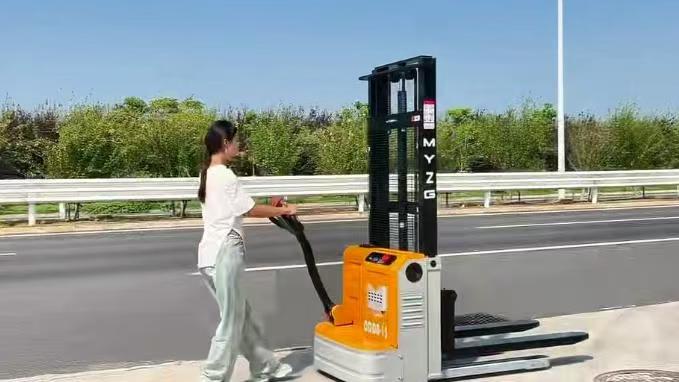
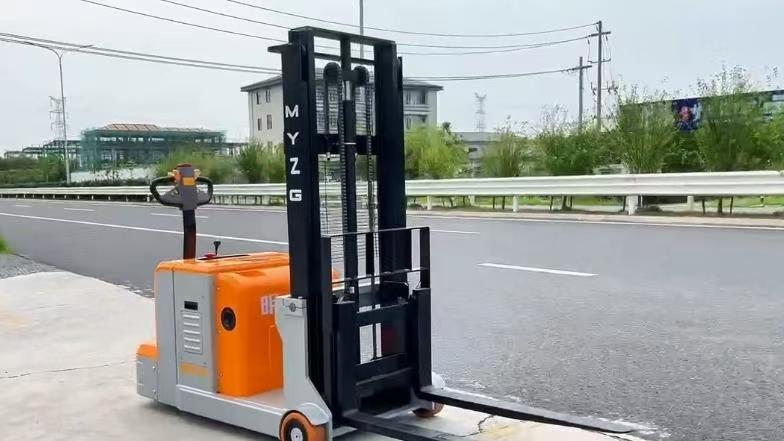
Pallet stackers are another option for lighter-duty applications. Walkie stackers are compact, easy to maneuver, and suitable for moving and stacking pallets over relatively short distances. They can be a cost-effective solution for small warehouses and businesses that do not require the performance of a full-size counterbalance forklift.
The choice between a reach truck, pallet stacker, and counterbalance forklift depends mainly on load capacity, lifting height, aisle dimensions, and operating frequency.
7. Electric Counterbalance Forklift vs. Reach Truck vs. Pallet Stacker
An electric counterbalance forklift is a versatile option for general warehouse operations. It can transport pallets, load trucks, unload goods, and handle a wide range of warehouse tasks. It is especially suitable when the warehouse has sufficient aisle space.
Reach trucks are more specialized. Their biggest advantage is high-density storage. If the warehouse has narrow aisles and high racks, a reach truck can make better use of the available floor area.
Pallet stackers are generally designed for lighter-duty applications. They are smaller and often more economical, making them suitable for short-distance pallet movement and lower-level stacking.
In simple terms, a counterbalance forklift is a versatile all-purpose solution, a reach truck is ideal for narrow aisles and high racks, and a pallet stacker is suitable for lighter warehouse handling tasks.
8. How Battery Technology Affects Indoor Forklift Selection
Battery technology has become an increasingly important factor when choosing an electric forklift.
Lead-acid batteries remain widely used because they are familiar to many warehouse operators and can provide reliable performance when properly maintained. However, they may require regular maintenance and dedicated charging areas.
Lithium-ion batteries offer several advantages for intensive warehouse operations. They can generally be charged during breaks or other short periods, which can be particularly useful for multi-shift applications. They also provide consistent performance during the discharge cycle and typically require less routine maintenance.
However, lithium-ion systems can have a higher initial purchase price. Therefore, companies should evaluate the complete operating cycle rather than comparing only the upfront forklift price.
For warehouses operating one shift with sufficient time for overnight charging, either battery technology may work well. For high-utilization, multi-shift operations, lithium-ion technology can be particularly attractive.
9. Safety Considerations for Indoor Forklift Operations
Safety should be one of the most important considerations when selecting and operating a warehouse forklift.
Visibility is essential. The operator should have a clear view of the load, surrounding workers, and travel path. Warehouse layouts should also provide clearly marked pedestrian routes and forklift travel areas.
Speed control is important in confined spaces. Forklifts should operate at appropriate speeds, particularly at intersections, blind corners, ramps, and areas with high pedestrian traffic.
Load stability must also be considered. Operators should never exceed the forklift's rated capacity, and loads should be positioned correctly on the forks. The actual lifting capacity can decrease at greater lifting heights or with certain attachments.
Daily inspections should include tires, forks, mast components, brakes, steering, hydraulic systems, warning devices, battery condition, and other important components. Proper operator training and regular maintenance are equally important for safe warehouse operation.
10. Cost Considerations: Purchase Price vs. Total Cost of Ownership
The purchase price is only one part of the cost of owning a forklift. Warehouse operators should also consider energy consumption, maintenance, battery costs, tires, spare parts, and expected service life.
Electric forklifts can have relatively low routine maintenance requirements because they do not use conventional engine oil and have fewer internal-combustion engine components. Energy costs can also be attractive depending on electricity prices and utilization.
LPG and diesel forklifts require regular engine-related maintenance and fuel expenses. However, their fast refueling capability can be valuable in high-utilization operations.
For this reason, companies should calculate the total cost of ownership rather than choosing equipment solely because it has the lowest purchase price. A forklift with a higher initial price may ultimately be more economical if it consumes less energy and requires less maintenance over its working life.
11. How to Choose the Right Forklift for Different Warehouse Scenarios
For a small warehouse with light loads, a pallet stacker or small electric forklift may be sufficient. These machines are compact and relatively easy to operate in limited spaces.
For a general distribution warehouse, an electric counterbalance forklift is often a strong choice because of its versatility and clean operation.
For a high-rack warehouse, a reach truck may be more suitable because it can operate efficiently in narrow aisles while providing substantial lifting height.
For a cold-storage warehouse, battery performance and charging characteristics should receive special attention. Equipment should be selected according to the specific temperature conditions and manufacturer recommendations.
For a food and beverage warehouse, low emissions, cleanliness, and noise control are especially important. Electric forklifts are often preferred for these applications.
For a multi-shift logistics center, battery capacity, charging infrastructure, and opportunity-charging capability should be carefully evaluated. Lithium-ion forklifts can be particularly useful when equipment must operate for long periods.
For warehouses handling very heavy loads, higher-capacity electric, LPG, or diesel forklifts may be considered depending on whether the operation is indoors, outdoors, or a combination of both.
12. Practical Forklift Selection Checklist
Before purchasing a forklift for indoor warehouse operations, managers should answer several basic questions:
What is the maximum load weight?
What is the required lifting height?
What is the narrowest aisle width?
What type of pallets are being handled?
How many operating hours are required per day?
How many shifts does the warehouse operate?
Is the warehouse fully enclosed?
Are there strict requirements for emissions or noise?
Is there sufficient space for battery charging?
Is opportunity charging required?
What type of floor does the warehouse have?
How much maintenance can the company accommodate?
What safety regulations apply to the facility?
What is the expected total cost of ownership?
Answering these questions makes it much easier to identify the appropriate forklift configuration.
13. Conclusion
So, which forklift type is most suitable for indoor warehouse operation? For many standard indoor warehouse applications, electric forklifts are the preferred choice. They offer quiet operation, no tailpipe emissions, precise handling, and good compatibility with smooth warehouse floors.
However, there is no single forklift that is perfect for every warehouse. Reach trucks are often better for narrow aisles and high-rack storage, while pallet stackers are practical for lighter-duty applications. LPG forklifts can be useful when rapid refueling and long operating periods are important, while diesel forklifts are generally better suited to heavy-duty or outdoor environments.
The best approach is to select a forklift based on load capacity, lifting height, aisle width, operating hours, warehouse environment, energy requirements, safety, and total cost of ownership. By matching the forklift to the actual warehouse conditions, businesses can improve productivity, reduce operating expenses, and create a safer and more efficient material-handling operation.
Post time:Aug.13.2026
