
How Much Does a New Backhoe Loader Cost?
1. Introduction
A new backhoe loader is one of the most versatile machines used in construction, agriculture, road maintenance, landscaping, utility work, and general material handling. Combining a front loader bucket with a rear excavator arm, a backhoe loader can perform several jobs with a single machine. This versatility makes it an attractive choice for contractors who need digging, trenching, loading, lifting, and site preparation capabilities without purchasing several different machines.
So, how much does a new backhoe loader cost? There is no single price that applies to every machine. The cost can vary substantially depending on engine power, operating weight, digging depth, hydraulic performance, transmission, emissions standards, attachments, brand, country of origin, and optional equipment. Entry-level machines may focus on affordability and basic functionality, while premium machines can cost considerably more because of advanced hydraulics, operator comfort, technology, and stronger components.
When comparing backhoe loader prices, buyers should also look beyond the initial purchase price. Freight, import duties, taxes, attachments, spare parts, maintenance, fuel consumption, and after-sales service can significantly affect the total cost of ownership. A machine with a slightly higher purchase price may ultimately provide better value if it offers lower operating costs, greater productivity, and reliable support.
This article explains the major factors affecting the price of a new backhoe loader, the typical cost differences between machine categories, additional expenses buyers should consider, and how to select a machine that provides the best value for a particular application.
2. Average Price of a New Backhoe Loader
The price of a new backhoe loader generally depends on the specifications and market in which it is purchased. As a broad industry guide, new machines can range from approximately US$30,000 to more than US$150,000, with premium models and highly customized configurations potentially costing even more.
Entry-level backhoe loaders are usually designed for lighter construction, agriculture, landscaping, and utility applications. They may have simpler cabins, smaller engines, standard hydraulic systems, and fewer optional features. Their lower purchase price makes them attractive to small contractors and buyers working within a limited budget.
Mid-range machines typically provide a balance between price, performance, and durability. They often feature four-wheel drive, stronger hydraulic systems, comfortable enclosed cabins, higher lifting capacity, and better digging performance. This category is commonly suitable for general contractors, infrastructure projects, farms, municipalities, and rental businesses.
Premium backhoe loaders from major international manufacturers generally command higher prices. They may include advanced hydraulic systems, sophisticated transmissions, electronic controls, premium operator environments, fuel-saving technologies, and extensive dealer support.
It is important to remember that a quoted machine price may not include transportation, taxes, attachments, or other costs. Therefore, buyers should compare the complete delivered cost, rather than comparing only the basic machine price.
3. Main Factors That Affect Backhoe Loader Prices
Several technical factors can have a major impact on the price of a new backhoe loader.
Engine power is one of the most obvious factors. A machine equipped with a higher-power engine can generally handle heavier workloads and demanding hydraulic operations, but the larger engine and associated components can increase the purchase price.
Operating weight also matters. Heavier machines generally use stronger frames, axles, hydraulic components, and structural parts. They can provide greater stability and digging performance but may cost more to manufacture and transport.
Digging depth is another important specification. A backhoe loader designed for deeper excavation may require a longer boom and dipper, stronger hydraulic cylinders, and a larger hydraulic system.
Hydraulic performance directly affects productivity. Higher hydraulic flow and pressure can improve digging speed and attachment performance. Machines equipped with auxiliary hydraulic circuits for breakers, augers, grapples, and other attachments may therefore have a higher price.
Transmission and drivetrain configuration also influence cost. Four-wheel-drive systems, powershift transmissions, automatic transmissions, and specialized axles can increase the purchase price while improving traction and productivity.
Finally, operator comfort and safety equipment can affect the cost. Features such as air conditioning, suspension seats, ergonomic controls, ROPS/FOPS protection, improved visibility, and electronic monitoring systems may increase the initial investment but can be valuable for machines used for long working hours.
4. Price Comparison by Backhoe Loader Size
Backhoe loaders can broadly be divided into compact, mid-size, and heavy-duty categories.
Compact backhoe loaders are designed for smaller jobs where maneuverability is more important than maximum digging force. They are useful for landscaping, residential construction, farm work, and utility projects. Their smaller dimensions can also make transportation easier.
Mid-size backhoe loaders are often the most versatile option. They provide a useful combination of digging depth, loader capacity, engine power, and maneuverability. Contractors can use them for road construction, drainage, trenching, building foundations, and material loading.
Heavy-duty backhoe loaders are intended for demanding construction and infrastructure projects. They generally provide greater digging force, lifting capacity, hydraulic performance, and durability. Naturally, these machines tend to have higher purchase prices.
Rather than simply choosing the largest machine available, buyers should consider the actual workload. A machine that is too small may have insufficient productivity, while an unnecessarily large machine can increase purchase, transportation, and operating costs.
5. Engine and Emissions Standards
The engine is one of the most important components affecting both purchase price and operating cost.
Different markets require different emissions standards. Machines intended for Europe may need to comply with EU Stage V requirements, while machines sold in North America may require appropriate EPA emissions compliance. Other markets may have different regulations or certification requirements.
Engines meeting stricter emissions standards can increase the initial cost because they may require additional emissions-control technology and more sophisticated engine-management systems.
However, buyers should not look only at the purchase price. Fuel efficiency, maintenance requirements, local fuel quality, spare-parts availability, and emissions regulations can all influence long-term operating costs.
For export buyers, it is especially important to confirm the emissions standard before placing an order. A machine that is inexpensive at the factory may not be suitable for the destination market if it does not meet local regulations.
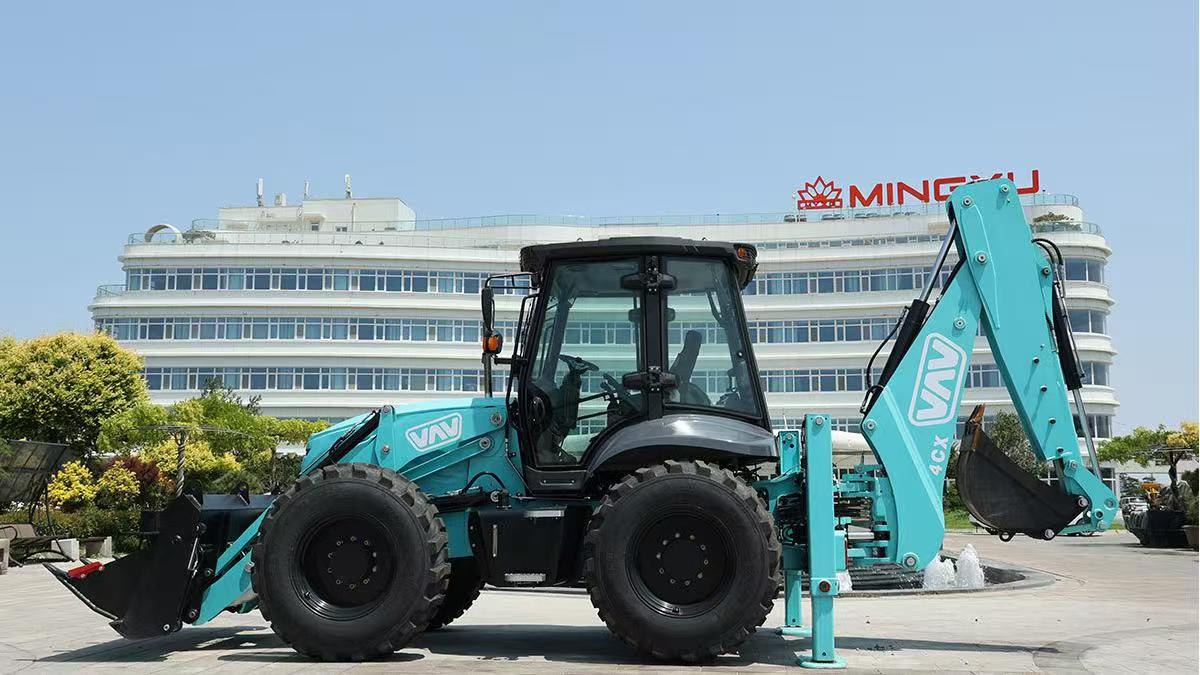
6. Backhoe Loader Features Worth Paying For
Not every optional feature provides the same value. Buyers should prioritize features that improve productivity, safety, or machine versatility.
Four-wheel drive is particularly useful on construction sites, farms, muddy ground, and uneven terrain. It provides improved traction compared with two-wheel drive.
An extendable dipper can increase digging reach and depth, making the machine more versatile for excavation work.
A hydraulic quick coupler allows operators to change compatible attachments more efficiently, reducing downtime.
Auxiliary hydraulic lines are valuable for customers who plan to use hydraulic breakers, augers, grapples, compactors, or other hydraulic attachments.
A comfortable enclosed cab with air conditioning and heating can also be worthwhile when operators spend many hours inside the machine.
For professional contractors, these features should be evaluated according to their expected working hours and applications rather than simply choosing the cheapest configuration.
7. How Attachments Change the Total Cost
The standard front loader bucket and rear digging bucket are usually included in the basic machine configuration, but additional attachments can significantly increase the total investment.
Common backhoe loader attachments include hydraulic breakers, augers, pallet forks, grapples, trenching tools, grading buckets, and specialized buckets.
For example, a contractor working on utility projects may need a narrow trenching bucket, while a demolition contractor may benefit from a hydraulic breaker. A landscaping company may prioritize grading and material-handling attachments.
When requesting a quotation, buyers should specify exactly which attachments they need. Purchasing compatible attachments together with the machine can sometimes simplify logistics and ensure proper compatibility.
The attachment should also match the machine's hydraulic flow, pressure, mounting system, and lifting capacity.
8. Additional Costs Beyond the Purchase Price
The advertised machine price is only one part of the total investment.
For an imported backhoe loader, international freight can be a significant cost. Buyers should consider whether the quotation is EXW, FOB, CIF, or another trade term.
Import duties, VAT or other taxes, port charges, customs clearance, inland transportation, and local registration may also apply depending on the destination country.
Other initial costs can include insurance, operator training, commissioning, spare parts, lubricants, and additional tools.
For this reason, an international buyer should calculate the total landed cost before comparing suppliers.
For example, a lower factory price does not necessarily mean a lower final cost if the machine has expensive transportation, higher import duties, limited parts availability, or inadequate local technical support.
9. Dealer Price vs. Direct Factory Purchase
Buyers generally have two main purchasing channels: buying from a local dealer or purchasing directly from the manufacturer or exporter.
A local dealer may provide advantages such as local inventory, maintenance support, operator training, spare parts, financing options, and easier warranty service. These services can justify a higher purchase price.
Direct factory purchasing can provide competitive pricing, especially for distributors, contractors purchasing multiple machines, or experienced importers. Buyers may also have greater flexibility in selecting engine specifications, attachments, colors, tires, and other configurations.
However, direct purchasing requires careful evaluation of the manufacturer's reputation, quality-control procedures, warranty policy, spare-parts support, export experience, and technical documentation.
The best supplier is therefore not necessarily the one offering the lowest quotation. The goal should be to find the best combination of price, machine quality, specifications, warranty, and after-sales support.
10. Backhoe Loader Ownership and Operating Costs
The purchase price is only the beginning of the financial calculation.
Fuel is usually one of the largest recurring expenses. Engine size, workload, operator behavior, terrain, and idle time can all influence fuel consumption.
Routine maintenance includes engine oil, hydraulic oil, filters, coolant, transmission oil, axle maintenance, and lubrication.
Wear components such as bucket teeth, cutting edges, tires, bushings, pins, and hydraulic components may eventually require replacement.
Downtime can also have a major financial impact. If a machine is unavailable during an important project, the contractor may lose productivity or need to rent another machine.
Therefore, buyers should evaluate the total cost of ownership, including purchase price, fuel, maintenance, repairs, depreciation, and expected resale value.
11. How to Get the Best Price on a New Backhoe Loader
Getting the best price does not necessarily mean negotiating the lowest possible number.
First, buyers should compare machines with similar specifications. Comparing a basic 4WD machine with a fully equipped premium model can lead to misleading conclusions.
Second, request a complete quotation that clearly lists the engine, transmission, tires, buckets, hydraulic options, attachments, warranty, and delivery terms.
Third, consider negotiating additional value rather than only reducing the machine price. For example, a supplier may be able to include spare filters, bucket teeth, tools, or additional attachments.
Buyers purchasing several machines may also have greater negotiating power.
Finally, always evaluate after-sales support. A slightly higher purchase price may be worthwhile if the supplier can provide reliable spare parts and technical assistance.
12. New Backhoe Loader Cost by Market
Prices vary between countries because of taxes, transportation, certification requirements, dealer networks, labor costs, and market demand.
In North America, major brands have strong dealer networks and machines often feature sophisticated emissions systems and technology.
In Europe, Stage V emissions compliance and strict safety requirements can contribute to higher machine costs.
In Latin America, price sensitivity is often an important consideration, while local parts availability and machine simplicity can also be significant.
In Africa, customers may place strong emphasis on durability, easy maintenance, fuel efficiency, and reliable parts supply.
In the Middle East, machines may need to operate in hot and dusty environments, making cooling performance, filtration, and air-conditioning systems important considerations.
For imported machines, buyers should always calculate the final cost after freight, customs, taxes, and local expenses.
13. New Backhoe Loader vs. Other Construction Machines
A backhoe loader's biggest advantage is versatility.
An excavator generally provides superior excavation performance, particularly for larger digging projects, but it does not provide the same front-loading capability.
A wheel loader is excellent for moving and loading materials but is less suitable for deep trenching and excavation.
A skid steer can provide excellent maneuverability and attachment versatility, particularly in confined areas, but its digging configuration is different from that of a traditional backhoe loader.
For contractors who need one machine to perform multiple tasks, the backhoe loader can therefore provide excellent value.
The correct choice depends on the percentage of time the machine will spend digging, loading, lifting, grading, transporting, and using attachments.
14. How to Choose a Backhoe Loader Based on Your Budget
A buyer with a limited budget should focus on essential specifications rather than premium options that will rarely be used.
For regular contractors, it may be worth spending more on four-wheel drive, hydraulic performance, operator comfort, and durability because these features can improve daily productivity.
Rental companies should prioritize durability, ease of operation, parts availability, and resale value.
Agricultural users may need a configuration optimized for farm roads, material handling, drainage, and general property maintenance.
Municipal and utility customers may place greater emphasis on safety, reliability, attachment compatibility, and long-term support.
The ideal machine is the one whose specifications match the actual workload.
15. Final Cost-Buying Checklist
Before purchasing a new backhoe loader, buyers should confirm:
Engine brand, model, and power
Emissions standard
Operating weight
Maximum digging depth
Loader bucket capacity
Backhoe bucket capacity
Hydraulic flow and pressure
Transmission type
Four-wheel-drive configuration
Tire specifications
Cab and safety configuration
Standard and optional attachments
Warranty period
Spare-parts availability
Delivery time
Incoterms and shipping costs
Import duties and taxes
Total landed cost
After-sales service
Getting these details in writing makes it much easier to compare quotations from different suppliers.
16. Conclusion
So, how much does a new backhoe loader cost? The answer depends heavily on the machine's size, specifications, brand, emissions standard, attachments, market, and purchasing method. New backhoe loaders can range from relatively affordable entry-level machines to premium models costing well over US$100,000.
The most important point is that buyers should not choose a machine based solely on its initial price. Engine performance, hydraulic capability, fuel efficiency, durability, attachments, maintenance costs, warranty, spare-parts availability, and after-sales support can all have a major impact on the machine's long-term value.
For contractors and equipment buyers, the best approach is to define the required digging depth, lifting capacity, working environment, attachments, annual working hours, and budget first. Then compare complete quotations from reliable suppliers.
A properly selected backhoe loader can serve as a highly versatile piece of equipment, allowing one machine to perform excavation, trenching, loading, lifting, grading, and material-handling tasks. When purchase price and total ownership costs are evaluated together, buyers can make a much more informed investment decision.
Post time:Sep.07.2026
