
How Much Does a Forklift Weigh?
1. Introduction
Forklifts are essential machines in warehouses, construction sites, ports, and manufacturing facilities. Whether you are moving pallets in a distribution center or handling heavy materials on a job site, forklifts play a critical role in improving efficiency and reducing manual labor. One of the most commonly asked questions by buyers, operators, and logistics planners is: how much does a forklift weigh?
The answer is not as simple as a single number. Forklift weight varies widely depending on the type, size, load capacity, and power source. Understanding forklift weight is crucial for several reasons, including safe operation, transportation planning, and ensuring that your working surface can handle the load.
In this article, we will explore the average weight of different types of forklifts, the factors that influence their weight, and why it matters when choosing the right machine for your needs.
2. Average Weight of Different Types of Forklifts
Electric Forklifts
Electric forklifts are widely used in indoor environments such as warehouses and factories. These machines are powered by large industrial batteries, which contribute significantly to their overall weight.
On average, electric forklifts weigh between 3,000 and 10,000 pounds (1,300 to 4,500 kg). Smaller three-wheel electric models tend to be lighter and more compact, making them ideal for tight spaces. In contrast, larger four-wheel models designed for heavier loads can weigh considerably more.
One important factor is the battery itself. Industrial forklift batteries can weigh anywhere from 800 to 4,000 pounds, acting as a built-in counterweight that enhances stability.
3. Internal Combustion (IC) Forklifts
Internal combustion forklifts run on diesel, gasoline, or LPG (liquefied petroleum gas). These machines are commonly used outdoors or in well-ventilated areas due to emissions.
IC forklifts are generally heavier than electric models, with a typical weight range of 5,000 to 20,000+ pounds (2,200 to 9,000+ kg). The added weight comes from the engine, fuel system, and more robust frame.
These forklifts are often preferred for heavy-duty applications because they offer higher power output and lifting capacity.
Rough terrain forklifts are specifically designed for outdoor use on uneven surfaces such as construction sites, farms, and lumber yards. They feature large pneumatic tires, reinforced frames, and higher ground clearance.
Due to their rugged construction, rough terrain forklifts usually weigh between 10,000 and 30,000+ pounds (4,500 to 13,500+ kg). Their heavier weight provides stability when operating on challenging terrain and lifting heavy loads.
5. Telehandlers (Telescopic Forklifts)
Telehandlers combine the functionality of a forklift and a crane. They are equipped with an extendable boom, allowing operators to lift loads to greater heights and distances.
These versatile machines are among the heaviest material handlers, typically weighing 15,000 to 35,000+ pounds (6,800 to 16,000+ kg). Their weight increases with larger boom sizes and higher lifting capacities.
Telehandlers are widely used in construction and agriculture due to their flexibility.
6. Pallet Jacks and Stackers
At the lighter end of the spectrum are pallet jacks and stackers. These machines are designed for lighter-duty tasks and shorter lifting heights.
Manual pallet jacks: 150–300 pounds (70–140 kg)
Electric pallet jacks: 1,000–2,000 pounds (450–900 kg)
Stackers: 1,000–3,000 pounds (450–1,300 kg)
While significantly lighter than traditional forklifts, they are still essential tools in warehouses and retail environments.
7. Key Factors That Affect Forklift Weight
Load Capacity
One of the biggest factors influencing forklift weight is its rated load capacity. Forklifts are designed with counterweights to balance the load they carry. As a result, higher-capacity forklifts require more mass to maintain stability.
For example, a 2-ton forklift will be much lighter than a 10-ton forklift because it does not need as much counterbalance.
8. Power Source
The type of power source also plays a major role. Electric forklifts rely on heavy batteries, while IC forklifts use engines and fuel systems.
Interestingly, electric forklifts can sometimes weigh as much as or even more than comparable IC models due to their battery weight.
9. Size and Dimensions
Larger forklifts naturally weigh more. Increased chassis size, longer wheelbases, and taller masts all contribute to additional weight.
Heavy-duty forklifts designed for industrial or port use are significantly larger and heavier than compact warehouse models.
10. Attachments and Accessories
Forklifts can be equipped with various attachments such as:
Side shifters
Fork positioners
Clamps
Extensions
These accessories add extra weight to the machine and can also affect its load capacity and balance.
11. Materials and Build Quality
The materials used in construction, particularly the thickness and quality of steel, impact overall weight. Heavy-duty forklifts built for harsh environments often use reinforced components, increasing their mass.
Why Forklift Weight Is Important
Transportation and Shipping
Knowing the weight of a forklift is essential when transporting it. Trucks, trailers, and shipping containers all have maximum weight limits.
For example, a standard 20-foot container has a payload limit, and exceeding it can lead to safety risks or additional costs.
12. Floor Load Capacity
Warehouse floors are designed to handle specific load limits. A forklift that is too heavy can damage the floor or create unsafe working conditions.
This is especially important in older buildings or multi-level facilities.
Stability and Safety
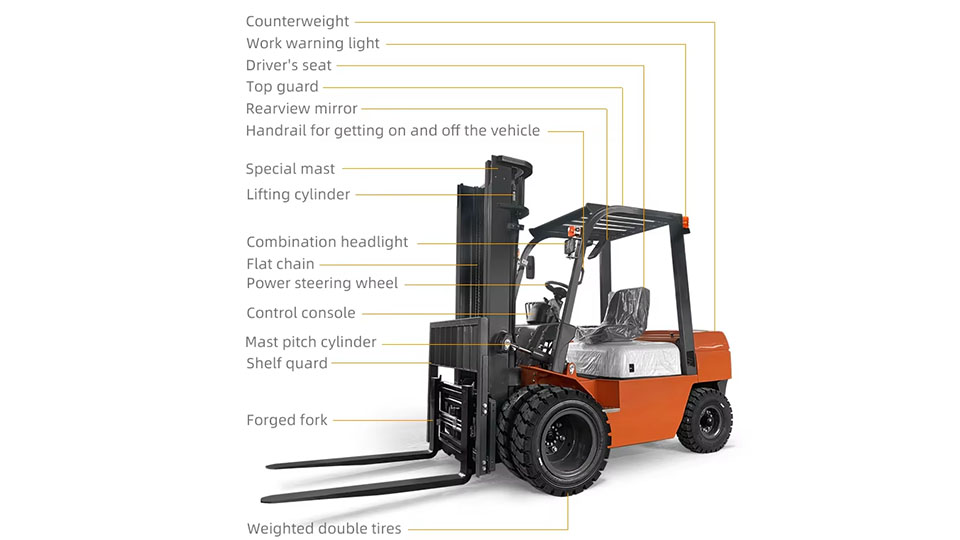
Forklift weight directly affects stability. The counterweight at the rear of the forklift balances the load being lifted at the front.
A properly weighted forklift reduces the risk of tipping, which is one of the most common causes of forklift accidents.
13. Compliance with Regulations
Workplace safety regulations often require operators and employers to consider equipment weight. Ensuring that forklifts are used within their design limits helps maintain compliance and reduce liability.
Forklift Weight vs Load Capacity
Understanding the Counterbalance Principle
Forklifts operate on a counterbalance system. The weight at the rear of the machine offsets the load at the front.
This is why forklifts are inherently heavy—without sufficient weight, they would tip forward when lifting loads.
14. Load Center and Stability Triangle
The concept of the “stability triangle” is critical in forklift operation. It refers to the area within which the forklift remains stable.
Changes in load position, height, or weight can shift the center of gravity and affect stability.
Common Misconceptions
A common misconception is that heavier forklifts are always better. While they can lift heavier loads, they may not be suitable for all environments.
For example, a very heavy forklift may not be ideal for indoor use due to floor limitations or maneuverability constraints.
15. How to Find the Exact Weight of a Forklift
If you need the exact weight of a specific forklift, there are several reliable methods:
Nameplate (data plate): Located on the forklift, it provides detailed specifications
Operator’s manual: Includes technical data
Manufacturer website: Most brands publish specifications online
Contacting the supplier: The most accurate source for custom configurations
Always verify the weight if you plan to transport or use the forklift in a sensitive environment.
16. Forklift Weight Comparison Overview
Here is a simplified comparison of typical forklift weights:
Electric forklifts: 3,000–10,000 lbs
IC forklifts: 5,000–20,000+ lbs
Rough terrain forklifts: 10,000–30,000+ lbs
Telehandlers: 15,000–35,000+ lbs
Pallet jacks/stackers: 150–3,000 lbs
This overview helps buyers quickly understand the differences between categories.
17. Tips for Choosing the Right Forklift Weight
Selecting the right forklift is not just about lifting capacity—it also involves choosing the appropriate weight for your application.
First, consider your working environment. Indoor warehouses typically require lighter electric forklifts, while outdoor construction sites demand heavier, more rugged machines.
Second, think about transportation. If you frequently move your equipment between locations, a lighter forklift may reduce logistics costs.
Third, evaluate your floor conditions. Ensure that your facility can safely support the combined weight of the forklift and its maximum load.
Finally, balance performance and cost. Heavier forklifts often come with higher purchase and operating costs, so it is important to choose a machine that meets your needs without exceeding them.
18. Conclusion
Forklift weight can range from as little as a few hundred pounds for manual pallet jacks to over 30,000 pounds for heavy-duty telehandlers. The exact weight depends on several factors, including type, load capacity, power source, and design.
Understanding forklift weight is essential for safe operation, efficient transportation, and proper equipment selection. By considering your specific application and working conditions, you can choose a forklift that delivers the best balance of performance, safety, and cost.
If you are planning to purchase or export a forklift, always verify its specifications carefully to ensure it meets your operational and logistical requirements.
Post time:Apr.01.2026
