
Walkie Stacker vs Counterbalance Stacker: Which Fits Narrow Warehouse Aisles?
1. Introduction
Warehouse operators are under constant pressure to maximize storage capacity while maintaining high levels of productivity and safety. As land prices, rental costs, and inventory volumes continue to rise, businesses are increasingly focusing on warehouse optimization. One of the most effective ways to improve storage density is by reducing aisle widths and utilizing material handling equipment specifically designed for compact spaces.
Among the most popular warehouse lifting solutions are walkie stackers and counterbalance stackers. Both machines are designed for pallet transportation and stacking, but they differ significantly in terms of design, maneuverability, aisle requirements, and load-handling capabilities. Choosing the wrong type of stacker can lead to inefficient warehouse layouts, increased operating costs, and reduced productivity.
The key question for many warehouse managers is simple: which machine performs better in narrow aisles? The answer depends on factors such as warehouse layout, pallet type, lifting height, traffic density, and operational requirements. This article provides a detailed comparison of walkie stackers and counterbalance stackers, helping warehouse operators select the best solution for narrow-aisle environments.
2. Understanding Walkie Stackers
A walkie stacker is a pedestrian-operated material handling machine designed to transport and stack pallets. The operator walks behind or alongside the machine while controlling its movement and lifting functions through a tiller handle.
Walkie stackers are available in three primary categories:
Manual stackers
Semi-electric stackers
Fully electric stackers
Most modern warehouses prefer fully electric walkie stackers because they offer greater productivity and reduced operator fatigue.
Typical specifications include:
Load capacity: 1.0–2.0 tons
Lift height: 2–6 meters
Electric drive and lifting systems
Compact chassis design
Walkie stackers are commonly used in:
Warehouses
Retail distribution centers
Food and beverage storage
Manufacturing facilities
Logistics hubs
Their compact size makes them particularly effective in narrow warehouse aisles where larger equipment may struggle to maneuver.
3. Understanding Counterbalance Stackers
A counterbalance stacker combines the stacking capability of a traditional stacker with the load-handling flexibility of a forklift. Instead of support legs extending beneath the load, it uses a rear counterweight to balance lifted loads.
This design provides several advantages:
Greater flexibility when handling pallets
Ability to access closed-bottom pallets
Easier loading and unloading operations
Improved versatility in mixed warehouse environments
Typical specifications include:
Load capacity: 1.0–2.5 tons
Lift height: 3–6 meters
Electric drive systems
Counterweight design similar to forklifts
Counterbalance stackers are frequently used in:
Manufacturing facilities
Warehouses with multiple pallet types
Loading docks
Production areas
Storage facilities with limited pallet standardization
Because they do not require support legs beneath the pallet, they can handle a wider range of loads than standard walkie stackers.
4. Why Aisle Width Matters in Warehouse Design
Aisle width is one of the most important factors affecting warehouse efficiency.
Every centimeter of aisle space occupies valuable storage area. Wider aisles allow easier equipment movement but reduce the number of pallet positions available. Narrow aisles increase storage density but require highly maneuverable equipment.
Warehouse managers must balance:
Storage capacity
Equipment accessibility
Safety requirements
Operational efficiency
Narrow aisle design offers several benefits:
Higher pallet density
Better space utilization
Reduced warehouse expansion costs
Improved inventory storage capacity
However, narrow aisles can create challenges such as:
Increased traffic congestion
Limited maneuvering space
Greater operator skill requirements
Higher risk of collisions
Selecting the appropriate stacker is critical to achieving the right balance between storage density and productivity.
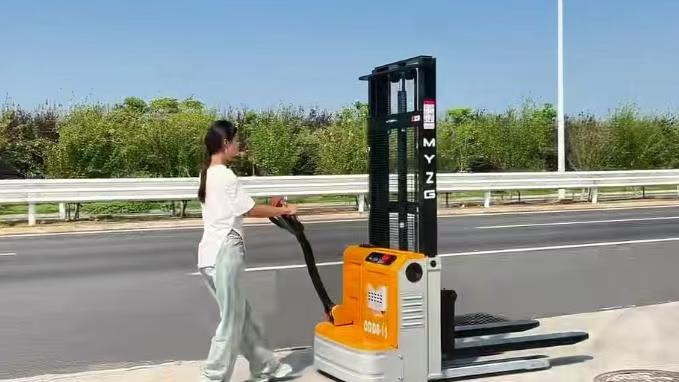
5. Maneuverability Comparison: Which Is Easier to Operate?
When operating in narrow aisles, maneuverability often becomes the deciding factor.
Walkie Stackers
Walkie stackers generally offer:
Smaller turning radius
Compact dimensions
Better maneuverability in tight spaces
Easier operation around shelving systems
Because the operator walks behind the machine, visibility is often excellent when positioning pallets.
Counterbalance Stackers
Counterbalance stackers typically require:
Larger turning radius
Additional rear clearance for the counterweight
More space during turns
However, they provide better load visibility because there are no support legs obstructing access to the pallet.
In extremely narrow aisles, walkie stackers usually have the advantage due to their compact footprint and tighter turning capabilities.
6. Space Requirements and Aisle Width Analysis
Aisle width requirements vary significantly between equipment types.
Typical aisle requirements:
2.0–2.5 meters for standard operations
Some compact models operate in even narrower aisles
Counterbalance Stackers
Typical aisle requirements:
2.8–3.5 meters depending on load dimensions
Additional turning space required
Consider a warehouse with 10,000 square meters of floor space. Reducing aisle width by even 30–50 centimeters can significantly increase pallet storage capacity.
In warehouses prioritizing maximum storage density, walkie stackers often provide the most efficient use of available space.
Counterbalance stackers may require wider aisles but compensate with greater flexibility when handling diverse pallet types.
7. Load Handling Capabilities
Load handling requirements vary widely across industries.
Walkie Stackers
Strengths include:
Excellent handling of standard pallets
Efficient stacking in racking systems
Stable operation with supported loads
Limitations include:
Difficulty with closed-bottom pallets
Restrictions when handling oversized loads
Counterbalance Stackers
Strengths include:
Handling of closed-bottom pallets
Improved flexibility for irregular loads
Greater versatility across applications
Because they operate without support legs, counterbalance stackers can often access loads that standard walkie stackers cannot.
For facilities dealing with multiple pallet types, counterbalance models may offer significant operational advantages.
8. Advantages of Walkie Stackers in Narrow Warehouses
Walkie stackers are often considered the ideal solution for narrow warehouse environments.
Key advantages include:
Compact Design
Their small footprint allows easy operation in confined spaces.
Reduced Turning Radius
Tighter turns improve maneuverability between racks.
Lower Purchase Cost
Walkie stackers generally cost less than counterbalance models.
Lower Maintenance Costs
Simpler construction often reduces maintenance expenses.
Better Space Utilization
Narrow aisle capability maximizes storage density.
Increased Warehouse Capacity
More racking can be installed within the same building footprint.
For warehouses focused primarily on standard pallet storage, walkie stackers often provide the highest return on investment.
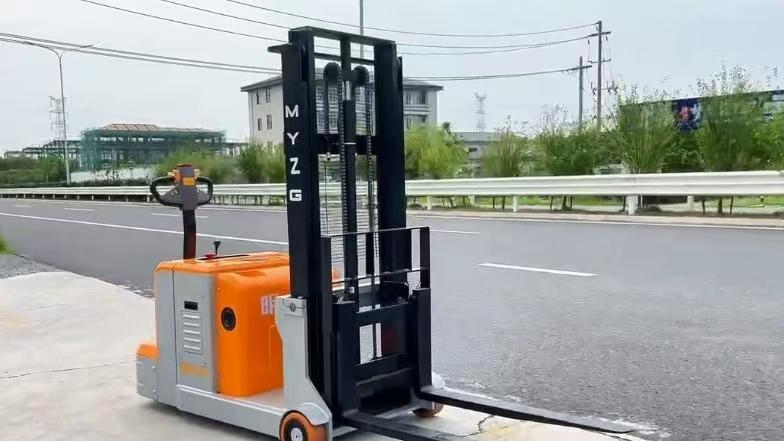
9. Advantages of Counterbalance Stackers
Despite requiring more aisle space, counterbalance stackers offer several important benefits.
Greater Load Flexibility
They can handle various pallet types and load configurations.
No Support Legs
This allows direct access to pallets from multiple directions.
Improved Dock Operations
Loading and unloading trucks becomes easier.
Better Handling of Special Loads
Counterbalance designs work well with oversized or irregular products.
Increased Application Range
One machine can often perform multiple warehouse tasks.
For facilities with diverse inventory and changing operational requirements, counterbalance stackers provide exceptional versatility.
10. Safety Considerations in Narrow Aisles
Warehouse safety becomes increasingly important as aisle widths decrease.
Pedestrian Safety
Narrow aisles reduce separation between workers and equipment.
Visibility Challenges
Operators must remain aware of rack corners and cross aisles.
Load Stability
Loads should always remain within rated capacity limits.
Speed Management
Lower travel speeds reduce accident risks.
Operator Training
Proper certification and training improve safety performance.
Warehouse Traffic Control
Clear markings and designated travel routes reduce collisions.
Regardless of equipment choice, safety procedures should always take priority over productivity goals.
11. Cost Comparison and Return on Investment
Equipment cost is an important consideration.
Walkie Stackers
Typical advantages:
Lower purchase price
Lower maintenance costs
Lower energy consumption
Lower operating expenses
Counterbalance Stackers
Typical advantages:
Greater operational flexibility
Reduced need for multiple equipment types
Improved handling capabilities
Although counterbalance stackers often cost more initially, their versatility may generate long-term savings in certain applications.
Warehouse managers should evaluate:
Equipment costs
Labor efficiency
Storage capacity gains
Maintenance expenses
Productivity improvements
The best ROI depends on the facility's specific operational needs.
12. Conclusion: Which Stacker Is Best for Narrow Warehouse Aisles?
Both walkie stackers and counterbalance stackers offer valuable benefits, but their suitability depends on warehouse requirements.
For warehouses focused on maximizing storage density and operating in very narrow aisles, walkie stackers are typically the better choice. Their compact design, smaller turning radius, lower costs, and superior maneuverability make them ideal for high-density storage environments.
Counterbalance stackers, on the other hand, excel in applications requiring greater load flexibility, handling of closed-bottom pallets, and versatile warehouse operations. Although they generally require wider aisles, they provide capabilities that standard walkie stackers cannot match.
Ultimately, warehouse managers should evaluate aisle width, pallet type, storage layout, lifting requirements, and long-term operational goals before making a decision. In many modern warehouses, the right stacker can significantly improve productivity, safety, and storage efficiency while reducing overall operating costs throughout 2026 and beyond.
Post time:Jun.12.2026
