
How Much Weight Can a Skid Steer Lift?
1. Introduction
A skid steer loader is one of the most versatile compact machines used in construction, agriculture, landscaping, road maintenance, material handling, and industrial applications. Its compact dimensions, maneuverability, and ability to use many different attachments make it useful for jobs ranging from moving soil and gravel to handling pallets, lifting construction materials, and loading trucks. However, one of the most important questions buyers and operators need to answer is: How much weight can a skid steer lift?
The answer depends on the machine's size, rated operating capacity, tipping load, hydraulic system, lift-arm design, attachment, load center, and operating conditions. Small compact skid steers may handle several hundred kilograms to around 1,500 kg, while larger heavy-duty models can have rated operating capacities of more than 2,500 kg and, in some cases, significantly higher. Therefore, looking only at the machine's overall size or engine horsepower is not enough to determine its actual lifting capability.
When comparing skid steer loaders, buyers will often encounter terms such as rated operating capacity (ROC), tipping load, and maximum lift capacity. These terms are related but are not necessarily interchangeable. Rated operating capacity is particularly important because it provides a practical indication of how much weight the machine is designed to handle under specified conditions without becoming unstable. Understanding these specifications helps buyers select the right machine and prevents them from choosing a model that is either too small for the job or unnecessarily large and expensive.
This article explains how skid steer lifting capacity is measured, what affects it, how different machine sizes compare, and how to select a skid steer for specific lifting applications. It also covers pallet handling, attachments, hydraulic performance, lift-arm design, and safe operating practices.
2. What Is the Typical Lifting Capacity of a Skid Steer?
There is no universal lifting capacity for skid steer loaders because machines are available in many different size classes. Compact models are designed for lighter work and often have a rated operating capacity below 1,500 kg. Medium-sized machines can commonly handle approximately 1,500–2,500 kg, while large heavy-duty skid steers can exceed 2,500 kg.
As a general reference, skid steers can be divided into three broad groups:
|
Skid Steer Size |
Approximate ROC |
Typical Applications |
|
Compact |
500–1,500 kg |
Landscaping, small construction, farms |
|
Medium |
1,500–2,500 kg |
Construction, material handling, agriculture |
|
Heavy-duty |
2,500–4,000+ kg |
Heavy construction, industrial handling, excavation |
These figures are only general ranges. The actual capacity depends on the manufacturer's specifications and the particular configuration of the machine.
For example, two skid steers with similar engine horsepower may have very different rated operating capacities. One may have a stronger lift-arm structure, larger hydraulic cylinders, a heavier counterweight, or a different center-of-gravity design.
Therefore, buyers should always check the rated operating capacity, tipping load, lift height, and attachment specifications rather than judging lifting performance from horsepower alone.
3. Understanding Rated Operating Capacity (ROC)
Rated operating capacity, commonly abbreviated as ROC, is one of the most important specifications when evaluating a skid steer loader.
ROC represents the amount of weight that the machine is designed to handle under the manufacturer's specified operating conditions. For many conventional skid steers, rated operating capacity is related to a percentage of the machine's tipping load.
The important point is that ROC is not necessarily the same as the absolute maximum weight the hydraulic system can physically lift.
A machine may theoretically be able to raise a very heavy load, but that does not mean the load can be safely transported or operated at that weight. Stability becomes increasingly important as the load gets heavier and moves farther away from the machine.
For buyers, ROC is therefore a much more useful number than simply asking, "How much can the hydraulic cylinders lift?"
When selecting a skid steer, the required working load should normally remain comfortably within the manufacturer's rated capacity rather than operating continuously at the machine's limit.
4. What Is the Tipping Load?
The tipping load is the load at which the machine reaches a point where its balance becomes unstable under a specified test configuration.
A skid steer works like a mechanical lever. As the loader arms raise a load, the load's position relative to the machine's center of gravity changes. When the load becomes too heavy or extends too far forward, the rear of the machine can become light and the machine can begin to tip.
This is why a skid steer may be able to lift a particular load when the arms are low but become less stable when the same load is raised higher or moved farther forward.
Tipping load should not be treated as the normal working capacity. Instead, the manufacturer's ROC provides a more appropriate reference for routine operation.
Operators should also understand that actual stability can change because of the ground surface, slopes, attachment type, load shape, load center, and machine configuration.
5. Factors That Affect How Much a Skid Steer Can Lift
Several factors influence the real-world lifting performance of a skid steer.
Machine operating weight: Heavier machines generally provide a more substantial base and can be designed for higher lifting capacities.
Hydraulic pressure: Higher hydraulic pressure can provide greater cylinder force, assuming the rest of the hydraulic system is designed accordingly.
Hydraulic flow: Flow primarily affects how quickly hydraulic functions operate. High flow does not automatically mean that a skid steer has a higher lifting capacity.
Lift-arm design: The geometry and structural strength of the lift arms have a major effect on lifting performance and stability.
Center of gravity: Machine balance changes as the loader arms move and as the load moves away from the machine.
Attachment weight: A heavy attachment reduces the amount of payload available for the material being lifted.
Load center: A load positioned farther forward creates more leverage against the machine and can significantly reduce practical lifting performance.
Ground conditions: Flat, firm ground generally provides better stability than soft, uneven, or sloping terrain.
Tire or track configuration: The machine's tires or tracks influence ground contact, traction, and stability.
These factors explain why the same skid steer may perform differently in different applications.
6. Radial Lift vs. Vertical Lift Skid Steers
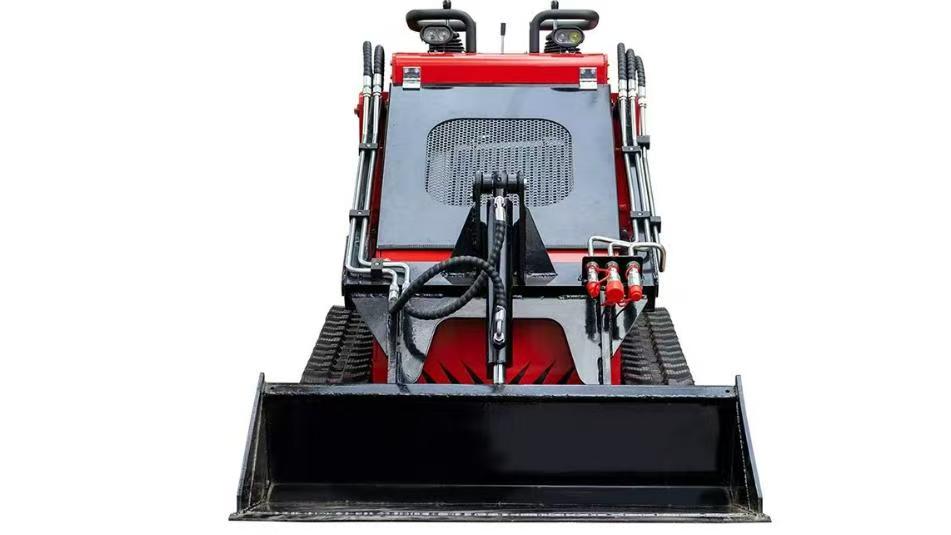
Skid steers are commonly available with either radial-lift or vertical-lift arm designs.
Radial-lift machines follow an arc as the loader arms move upward. They are often well suited to applications where digging, grading, and working at lower or intermediate heights are important.
Vertical-lift machines use a lift-arm geometry that keeps the attachment farther forward as the arms rise. This makes them particularly useful for applications such as loading trucks, placing materials, and handling pallets at greater heights.
The choice between the two designs depends on the job.
For example, a construction company that frequently loads materials into trucks may prefer a vertical-lift skid steer because of its reach at higher elevations. A contractor focused heavily on excavation, grading, and ground-level work may find a radial-lift machine suitable.
Neither design should automatically be considered "stronger." The actual lifting capacity depends on the specific model and manufacturer specifications.
7. How Hydraulic Capacity Affects Lifting Performance
The hydraulic system is a critical component of a skid steer loader.
The hydraulic system supplies force to the lift cylinders and attachment functions. Hydraulic lifting force is influenced by factors such as hydraulic pressure, cylinder size, hydraulic efficiency, and lift-arm geometry.
A larger hydraulic cylinder can generate greater force at the same hydraulic pressure. However, increasing cylinder size alone does not necessarily produce a better overall machine because the lift arms, frame, axles, tires, counterweight, and other components must also be designed to handle the increased force.
Hydraulic flow is another commonly misunderstood specification. High hydraulic flow is especially useful for attachments such as hydraulic breakers, augers, brush cutters, trenchers, and other high-flow tools. However, high hydraulic flow should not automatically be interpreted as a higher lifting capacity.
When comparing machines, buyers should therefore consider the entire hydraulic system rather than focusing on one specification.
8. How Much Can Different Skid Steer Sizes Lift?
The capacity of a skid steer generally increases with machine size, although there is considerable variation between models.
Compact skid steers are useful where access and maneuverability are more important than maximum lifting capacity. They are commonly used for landscaping, small farms, residential construction, and maintenance work.
Medium-sized skid steers offer a balance between maneuverability and lifting capability. They can handle many construction and agricultural applications while remaining relatively compact.
Heavy-duty skid steers are designed for demanding material-handling and construction applications. They typically have stronger frames, larger hydraulic systems, heavier operating weights, and higher rated capacities.
When comparing machines, buyers should create a specification table containing:
Operating weight
Rated operating capacity
Tipping load
Maximum lift height
Forward reach
Hydraulic pressure
Standard and high-flow hydraulic output
Engine power
Attachment capacity
This provides a much clearer picture of the machine's capabilities than engine power alone.
9. Can a Skid Steer Lift Pallets?
Yes, many skid steers can handle pallets when equipped with a suitable pallet fork attachment.
Pallet handling is particularly common on construction sites, farms, warehouses, landscaping projects, and industrial facilities.
However, the machine's ROC should not be the only number considered. The operator also needs to consider the weight of the pallet, the weight of the forks, and the load center.
For example, if a machine has a certain rated capacity and the fork attachment itself weighs several hundred kilograms, the actual material being handled must remain within the applicable operating limits.
Load position is also important. A pallet positioned close to the machine is generally easier to handle than the same pallet extended far forward.
Before using a skid steer for pallet handling, operators should check the machine's operating manual and the specifications of the fork attachment.
10. Can a Skid Steer Lift Heavy Materials?
Skid steers can lift a wide range of materials when the machine and attachment are correctly matched to the application.
Common examples include:
Concrete blocks
Bricks
Construction materials
Gravel and aggregate
Logs and timber
Landscaping materials
Scrap materials
Industrial components
Bagged materials
Pallets
Different jobs require different attachments. A bucket is suitable for loose materials, while pallet forks are better for palletized goods. Grapples can be useful for logs, brush, and irregular materials.
The attachment must always be rated for the intended load, and the combined machine-and-attachment configuration must remain within the manufacturer's operating limits.
11. How Attachment Weight Reduces Payload
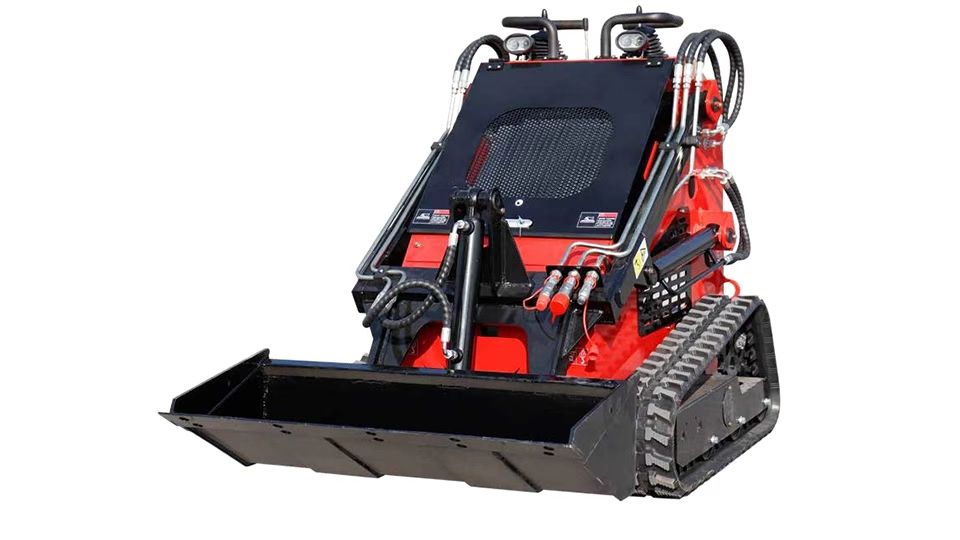
One of the easiest mistakes when calculating lifting capacity is forgetting the weight of the attachment.
Suppose a skid steer has a rated capacity of 2,000 kg and the selected attachment weighs 300 kg. The operator cannot simply assume that the machine can safely handle a 2,000 kg material load in that configuration.
The attachment changes the overall weight distribution and load geometry.
A simplified calculation might look like:
Available material weight = Rated capacity − attachment weight
Using the example:
2,000 kg − 300 kg = 1,700 kg
However, this is only a simplified illustration, not a substitute for the manufacturer's load chart or operating instructions. Load center and attachment geometry can also significantly affect actual capacity.
This is why attachment specifications are an essential part of skid steer selection.
12. Safe Lifting Practices
Safe operation is just as important as the machine's rated capacity.
Operators should:
Keep loads as low as practical while traveling.
Avoid carrying loads on steep slopes.
Operate on firm and reasonably level surfaces.
Avoid sudden acceleration, braking, or steering movements.
Keep the load properly positioned.
Never exceed the manufacturer's rated capacity.
Use attachments designed for the machine.
Inspect the machine and attachment before operation.
Follow the manufacturer's operating manual.
Ensure operators receive appropriate training.
The heavier the load and the farther it is positioned from the machine, the more important stability becomes.
A machine should never be intentionally operated at or beyond its tipping limit simply because the hydraulic system appears capable of raising the load.
13. How to Choose a Skid Steer Based on Lifting Requirements
The best way to select a skid steer is to start with the actual application rather than choosing a machine based only on horsepower.
First, determine the maximum load weight that needs to be handled.
Next, determine the attachment weight and load center. Then establish how high the load needs to be lifted and how far forward it needs to reach.
For example, loading a 2,000 kg pallet into a truck may require a different machine from moving a 2,000 kg bucket of material at ground level.
Buyers should also consider:
Required rated operating capacity
Required lift height
Required forward reach
Attachment type
Hydraulic flow requirements
Operating environment
Machine width and access restrictions
Tire or track configuration
Transport requirements
Local service and parts availability
A properly selected machine will provide sufficient capacity without being unnecessarily large for the application.
14. Example: Choosing a Skid Steer for a 2,000 kg Load
Suppose a contractor needs to move a 2,000 kg pallet.
The first step is to identify the attachment. If pallet forks weigh 300 kg, the total load being supported by the machine becomes approximately 2,300 kg.
The next step is to consider the load center. A pallet's center of gravity may be positioned significantly forward of the fork carriage, especially if the pallet is large or the load is uneven.
The contractor must then check the manufacturer's specifications for the exact skid steer and fork configuration.
A machine with a rated operating capacity of exactly 2,000 kg may therefore not be the ideal choice for a 2,000 kg pallet. A higher-capacity machine may provide a more appropriate safety margin and better performance.
The required lift height must also be considered. A machine's capacity can vary depending on the position of the load and lift arms.
15. Frequently Asked Questions
What is the maximum weight a skid steer can lift?
It depends on the model. Compact skid steers may handle less than 1,500 kg, while heavy-duty machines can have rated operating capacities above 2,500 kg and, for certain models, considerably higher.
Is ROC the same as maximum lifting capacity?
No. Rated operating capacity is a standardized operating specification, while the maximum hydraulic lifting force can be a different figure. ROC is generally more useful when evaluating normal operating capacity.
Can a skid steer lift a 2-ton pallet?
Some medium and heavy-duty skid steers can handle a 2-ton pallet, but the exact answer depends on the machine's rated capacity, attachment weight, load center, lift height, and operating conditions.
Does a vertical-lift skid steer lift more?
Not necessarily. Vertical-lift machines are often advantageous for reaching higher and farther forward, but lifting capacity varies by model.
Does attachment weight affect lifting capacity?
Yes. The attachment becomes part of the load carried by the machine and also affects the machine's balance and load geometry.
Can adding counterweights increase lifting capacity?
Counterweighting can influence machine stability, but operators should never add unauthorized weights or modify the machine in an attempt to exceed the manufacturer's rated capacity.
What happens if a skid steer is overloaded?
Overloading can reduce stability, affect steering and braking, increase component stress, and create a serious risk of tipping or equipment damage. Loads should always remain within the manufacturer's specified limits.
16. Conclusion
So, how much weight can a skid steer lift? The answer varies widely depending on the machine. Compact models may have rated operating capacities of several hundred kilograms to around 1,500 kg, medium machines may commonly fall in the 1,500–2,500 kg range, and heavy-duty skid steers can exceed 2,500 kg.
However, the most important specification is not simply the maximum weight the hydraulic cylinders can raise. Buyers and operators should consider rated operating capacity, tipping load, attachment weight, load center, lift height, hydraulic performance, and ground conditions together.
For material handling, pallet work, construction, agriculture, and industrial applications, selecting a skid steer with adequate capacity provides better productivity and safer operation. Instead of choosing the smallest machine that can theoretically lift a particular load, it is better to evaluate the complete working configuration and select a machine that comfortably meets the requirements.
Ultimately, the right skid steer is the one whose rated capacity, lifting geometry, hydraulic system, attachment compatibility, and operating environment match the actual job.
Post time:Sep.08.2026
